
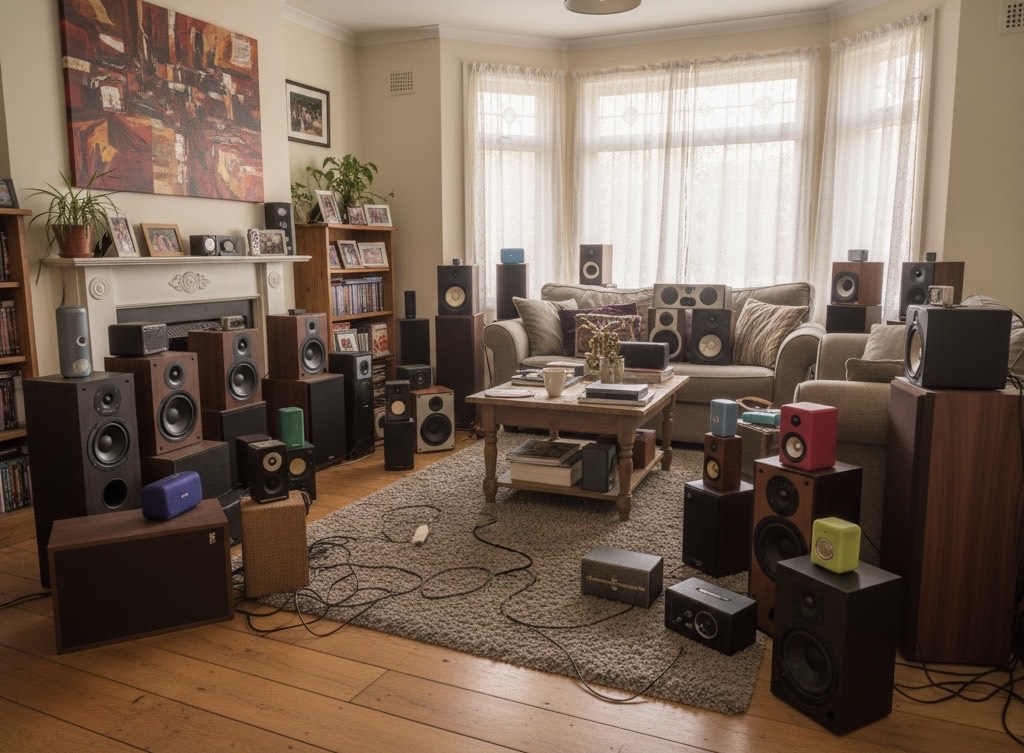
When asked about how to choose speakers, one must first consider the location of use, connection methods, sound quality and output relative to size, power source, and even interior design compatibility.
Of course, budget is also an important factor.
However, if you can find a speaker that allows you to face and answer the questions of "What has this speaker evolved toward?" and "Why was it born as a product?", such a speaker will surely maintain and improve your QOL (Quality of Life).
I would like to present one answer to the question: "This is another way to choose speakers."
We humans are the only creatures on Earth that have created artificial objects that do not exist in nature.
Perhaps because of this, while living surrounded by artificial materials like concrete, aluminum, and glass, we live with an intense desire for nature.
Visually, what we find most appealing is probably greenery.
Plants are almost invariably placed against gray walls and large glass surfaces.
In terms of taste, foods are strictly selected, artificial ones are avoided, and organic ingredients are chosen.
It's clear that continuously eating junk food simultaneously erodes both mind and body.
For touch, natural fibers are preferred—clothing, things we touch, things we sit on, things we sleep on—all have very strong sensors oriented toward nature.
Even with fragrance, artificial scents from perfumes to deodorizers are disliked unless they are naturally derived—they literally "get up our nose," as the saying goes.
What about hearing, then? What about sound?
Of course, artificial sounds are not preferred, but even when we want to choose more natural sounds, there have been no options available.
Even if we recorded very realistic forest sounds in a deep forest, the speakers that reproduce them would produce highly directional, linear artificial sound, resulting in a listening experience far removed from natural sound.
Despite this strong desire for "nature," until now there has been no way to choose it even when we wanted to.
For example, in terms of touch, the electric fan was already perfected as an industrial product 150 years ago.
At that time, for hearing, Edison had just invented the phonograph.
Electric fans never strayed from the path of trying to get closer to natural wind, evolving through oscillation, 1/f fluctuation wind patterns, and finally into air conditioners that deliver pleasant air throughout entire rooms.
Speakers, on the other hand, evolved in completely the opposite direction—to create three-dimensional sound, they developed 2-channel stereo, then 5.1ch surround, and now the cutting-edge 22.2ch system where sitting alone at the center point surrounded by 24 speakers supposedly produces very natural sound—creating a very unnatural scene.
I don't know where the direction of evolution was lost, but speakers that reproduce "sound" in the auditory field have followed this path.
Now, it already exists, right here. M's System's wave-motion speaker.
Natural sound spreads naturally.
Criteria for Choosing Speakers|M's System Main Store・Showroom - Official Site -


More from our Blog
You may also be interested in
Latest in "CEO Blog"

細胞はどこで音を受け取っているのか?
細胞はどこで音を受け取っているのか――細胞膜・接着部位・細胞骨格という“入り口”について前回は、細胞がただ音に反応しているだけでなく、周波数や音圧、波のかたちと…
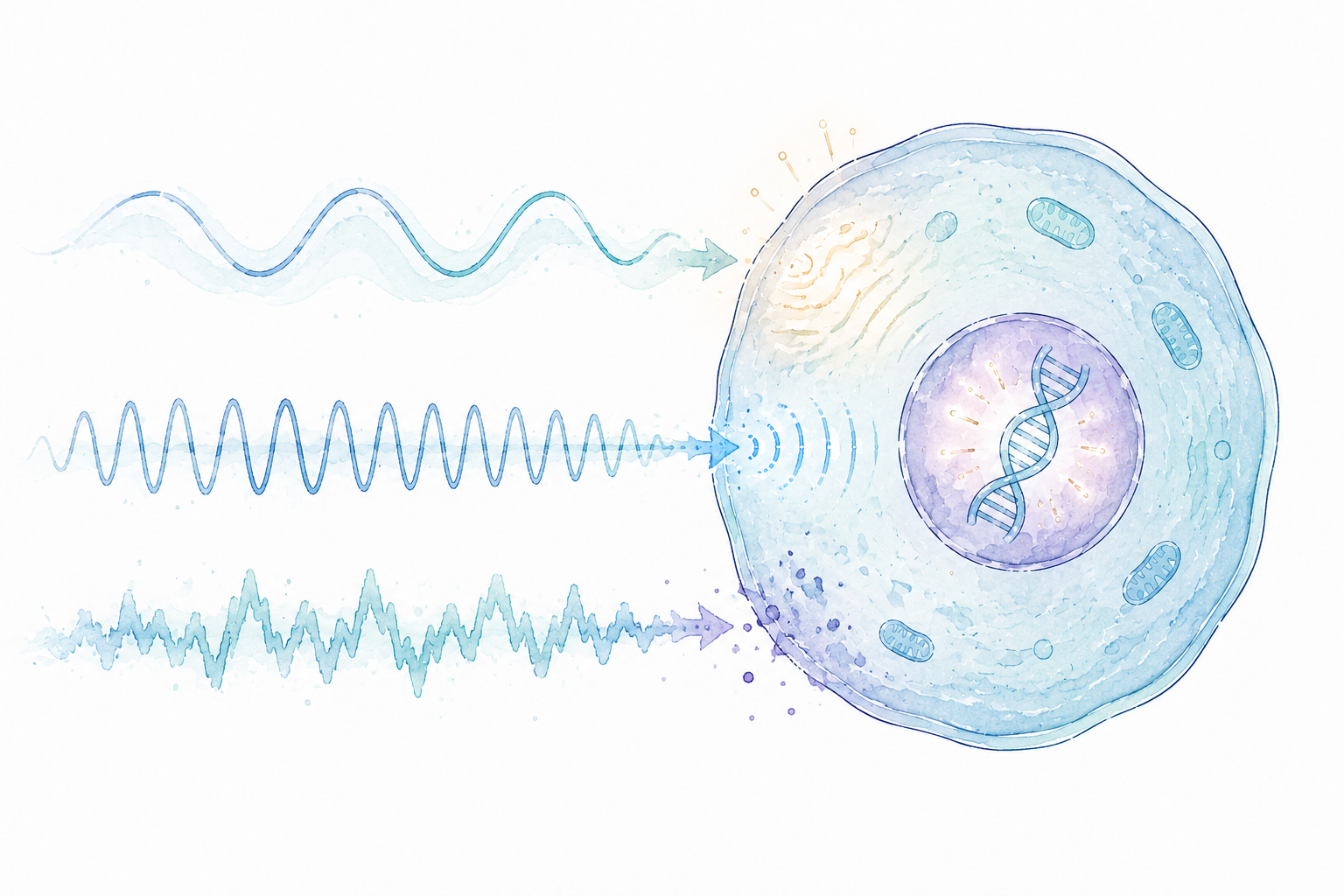
細胞は音の何を感じているのか?
細胞は音の何を感じているのか――「音楽」ではなく、「振動の質」という視点前回は、細胞そのものが可聴域の音に反応し、遺伝子の働きに変化が生じる可能性を示した研究を…

細胞は音に反応するのか?
細胞は音に反応するのか――音を「耳で聴くもの」から、もう一度考え直してみる私たちはふつう、音を耳で聴くものだと考えています。音楽を楽しむ。声を聞き取る。物音に気…
Latest Articles
細胞はどこで音を受け取っているのか?
細胞はどこで音を受け取っているのか――細胞膜・接着部位・細胞骨格という“入り口”について前回は、細胞がただ音に反応しているだけでなく、周波数や音圧、波のかたちと…
細胞は音の何を感じているのか?
細胞は音の何を感じているのか――「音楽」ではなく、「振動の質」という視点前回は、細胞そのものが可聴域の音に反応し、遺伝子の働きに変化が生じる可能性を示した研究を…
細胞は音に反応するのか?
細胞は音に反応するのか――音を「耳で聴くもの」から、もう一度考え直してみる私たちはふつう、音を耳で聴くものだと考えています。音楽を楽しむ。声を聞き取る。物音に気…
Catalog Request
Product catalogs, customer voices, media features & more. Request materials here.
Newsletter
New products, events & more. Stay up to date with our latest news. Subscribe here.
Book a Session
Reserve your listening session.
Contact Us
Products, maintenance, events & more. Get in touch with us. We'd love to hear from you.